Topic Study 02 · Scale & Sculpt Lighting

Give Miniature Pieces a Stronger Frame

Whether your table features painted Citadel miniatures, sundrop-shaded resin mechs from Scythe, or silk-screened wooden woodland warriors, small pieces need deliberate horizon control and edge light to reveal their silhouette.

Find My Next Tabletop Frame

Lowering the Horizon Line to Eye Level

When players sit around a table, they view game pieces from roughly 40 to 50 degrees above the board. That vantage point is practical for reading map icons, but it foreshortens sculpted figures—turning a towering plastic dragon from Blood Rage or Gloomhaven into a squashed top-down plastic blob.
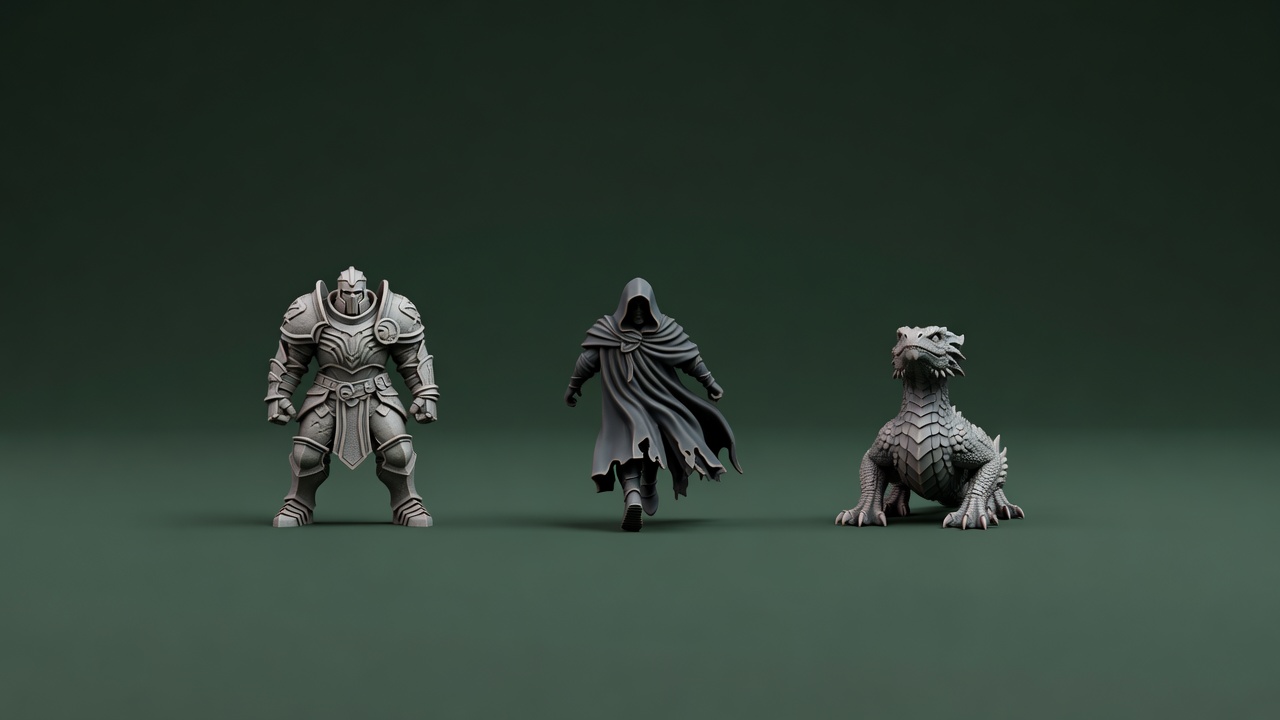
Soft-lit 3D render study of three tabletop miniatures photographed from a 10-degree low horizon on a plain dark green surface
Visual Study MF-01: 10° lens elevation aligning miniature shoulders with background terrain cards. 3D Render Study

In Visual Study MF-01, we bring the optical axis down to just 2.5 centimetres above the table felt (a 10-degree inclination). Notice three immediate compositional shifts:

  • H1

    Heroic Proportions Return

    Sculpted faces, raised banners, and weapon silhouettes project cleanly against the soft out-of-focus background rather than blending into the printed hexes below their bases.

  • H2

    Inverted Smartphone Trick

    If you are shooting with a phone, flip the handset upside down so the camera module sits millimetres off the table surface, giving you an instant worm's-eye perspective.

Depth-of-Field & Focal Distance Guide for Small Pieces

When working within 15 to 30 centimetres of a 28mm figure, depth of field becomes razor thin—even on smaller sensors. Use this studio reference table to balance sharpness across a squad of pieces:

Camera / Lens Setup Working Distance Recommended Aperture Depth Zone Behaviour
Smartphone 2x / 3x Telephoto Lens 22 cm – 30 cm Fixed (Native optical, avoid digital Portrait blur) Keeps a full 32mm base sharp while softly blurring resource trays 15cm behind
APS-C / Full Frame + 50mm Standard 35 cm – 45 cm f/5.6 to f/8 Ideal for three-figure triangular skirmish formations on hex grids
Dedicated 60mm or 90mm Macro Lens 18 cm – 25 cm f/11 to f/16 (Tripod or beanbag rest) Required to hold both the tip of an outstretched sword and the figure's eyes in focus

Framing Wooden Meeples & Screen-Printed Tokens

Flat-sided wooden pieces—like the custom beasts in Agricola or the faction warriors in Root and Ahoy—behave differently from 3D sculpted plastic. Because their front face is completely planar, lighting them straight-on flattens their silhouette.

Turn wooden pieces 20 degrees away from the key light so the timber edge catches a crisp highlight while the silk-screened front face remains evenly illuminated without glare.

Next Step: Graphic Component Patterns

After giving individual miniatures their moment, explore how dice, tiles, and resource tokens can be arranged into striking geometric compositions.

Continue to Component Studies →