The Three-Zone Tabletop Architecture
When art-directing a tabletop study for games with heavy table presence—such as Ark Nova, Terraforming Mars, or Cole Wehrle's Oath—the biggest visual adversary is edge-to-edge compression. If a player's personal tableau touches the central map with zero negative space, the camera reads the entire surface as a single noisy texture.
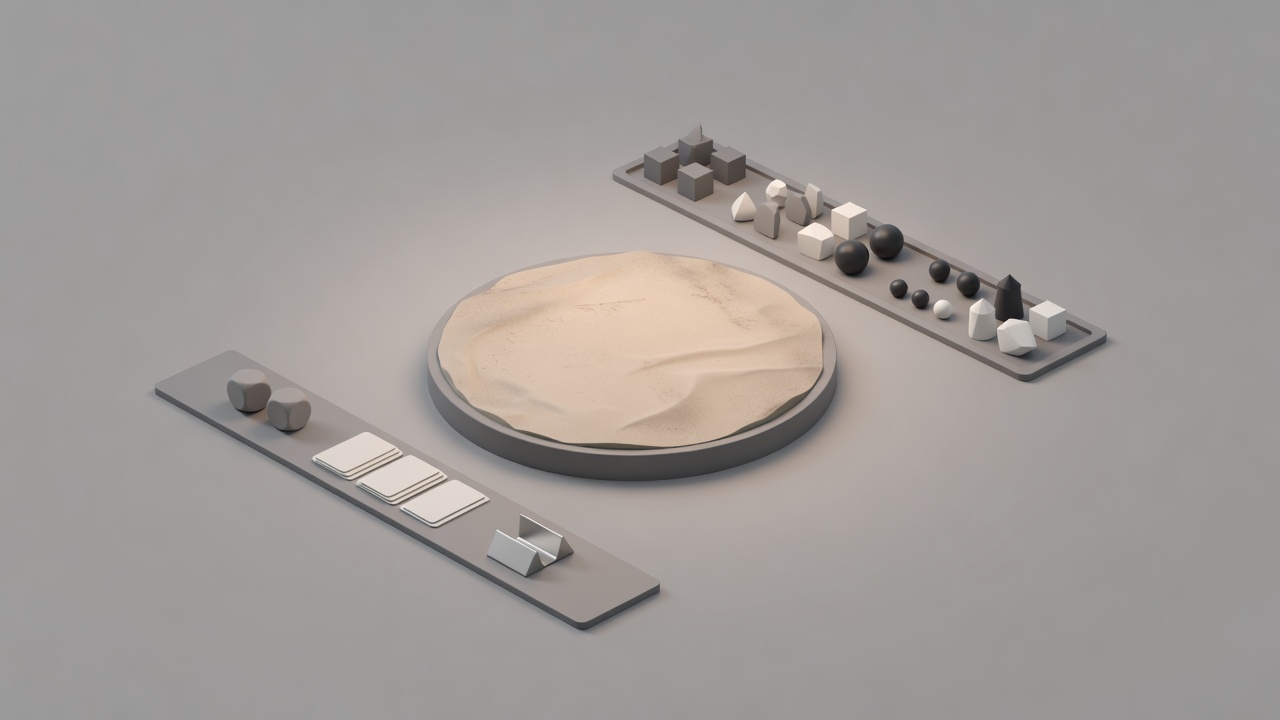
In our 3D spatial studies above, we divide the table into three concentric zones separated by visible strips of dark emerald or charcoal wool felt:
-
The Central Arena (Primary Focal Plane)
Reserved exclusively for the main board, active round tracker, and shared market display. Keep box lids, rulebooks, and unused expansion trays completely out of this core rectangle.
-
The 5cm Felt Breathing Channel
A continuous strip of unobstructed table surface between the central board and each player's personal area. In photographs, this dark frame acts like a gallery mat board, giving crisp edges to cardboard maps.
-
The Perimeter Utility & Hospitality Strip
Resource bowls, dice towers, and coasters sit at the outer corners where hands can reach them easily without casting shadows across the main board.